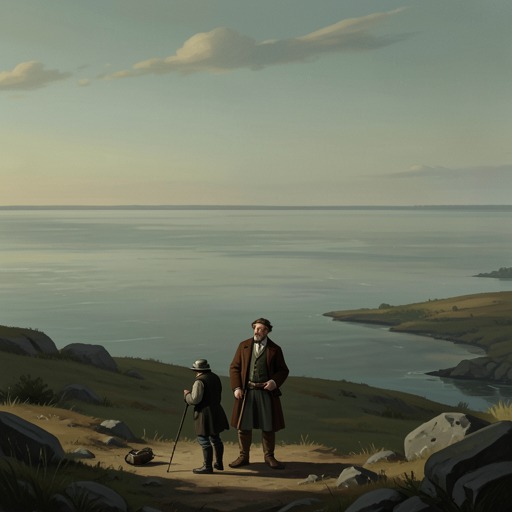
Central Sea raft expedition
A Journey to the Centre of the EarthThe Central Sea raft expedition is the explorers’ attempt to travel across the underground sea by a vessel built from the strange wood found on its shore. Hans’s practical ingenuity makes the crossing possible, and the voyage opens a route into unknown regions; yet discovery and danger grow together. A catch from the water and the sight of immense marine creatures unsettle the travelers, while a storm eventually wrecks the raft and reverses their course. The expedition ends not at a distant destination but back on the coast from which it began.
Building a Vessel
The project begins when Henry Lawson finds Hans working beyond the promontory that forms their natural harbor. On the sandy shore lies a half-finished raft made from an unfamiliar wood, with additional limbs, joints, boughs, and pieces scattered nearby. Hans has found the material ready to hand and begun shaping it into a vessel. His work surprises Henry, who had not expected a means of crossing the sea to emerge from the resources of the shore.
By the following evening, Hans has finished the raft. It is about ten feet long and five feet wide, its beams bound firmly together with stout ropes. The explorers launch it through their united effort, and the improvised craft floats on the water of the Central Sea. Its construction is a practical answer to a problem of scale: the sea cannot be crossed on foot, but a simple vessel made from local materials can carry the expedition onward.
Setting Out
On August 13, the party rises early to begin a new mode of travel, chosen for speed and to avoid the fatigue of walking. The rig is assembled from what they have: a mast of two pieces of wood joined for strength, a yard made from another piece, and a linen bed sheet for a sail. They have cordage, and the completed arrangement proves solid and seaworthy on trial.
At six in the morning, Professor Hardwigg gives the signal to embark. The raft carries the provisions, luggage, instruments, weapons, and a good supply of fresh water collected from springs in the rocks. Hans has devised a rudder that allows him to steer the craft with ease, and he takes the tiller. Henry releases the painter holding the raft to shore; the sail catches the wind, and the party moves rapidly out from the harbor. The departure begins a journey toward distant and unknown regions, with the raft’s modest materials carrying everything the explorers need for the crossing.
Signs from the Water
The next day brings a first test of what the underground sea contains. Around midday, Hans prepares a hook, conceals it with a small piece of meat, and casts his line into the water. Henry has wondered whether there are fish below the surface; after a long wait, a tug answers the question. Hans draws in a struggling fish, which Henry identifies as a small sturgeon. The catch is a concrete sign that the sea supports animal life, not merely a route across an unexplored expanse.
The expedition’s observations soon take a more alarming turn. The travelers see liquid columns rise high above the sea and fall back with a crash. They realize that the marine creatures before them are immense enough for even the smallest to threaten the raft and its occupants. Hans tries to steer away, but the danger appears on another side as well: a broad turtle and a long, serpent-like creature move through the water nearby. The party finds no obvious direction of escape as the creatures circle the vessel. The raft, which had made the sea traversable, now leaves its passengers exposed on the surface among beings of overwhelming scale.
Storm and Reversal
The crossing’s decisive reversal comes with a violent change on the southern horizon. Accumulated vapors become rain, and the movement of air develops into a tempest that rages from multiple directions. The raft rises and falls on the waves. Henry tries to lower the sail as a precaution, but Professor Hardwigg insists on keeping it raised, hoping that the wind may carry them within sight of a coast, even at the risk of the raft breaking apart.
A terrible shock casts the raft onto a rocky shore. Henry cannot clearly recount the moment: he remembers being thrown into the waves and then being saved when Hans seizes his arm. Hans carries him beyond the reach of the waves and lays him on the sand beside Professor Hardwigg. He then returns toward the rocks to look for anything from the wreck that can be recovered. The survival of the travelers and the loss of the raft mark the end of the sea voyage as planned.
The Route Reversed
After the wreck, Henry examines the compass with Professor Hardwigg. The needle points north, toward the shore, rather than toward the open sea in the direction the party had understood as south. It appears undamaged, and when they try to move it, it returns to the same unexpected bearing. The instrument’s behavior turns the wreck from an isolated accident into evidence about the journey’s course.
The travelers conclude that a sudden shift in the wind during the tempest must have escaped their notice. The raft was carried back across the sea to the shore they had left days earlier. The expedition’s route has therefore been reversed: the storm does not deliver them to the hoped-for distant coast, but returns them to familiar ground after destroying their means of travel. In the wider journey, the episode makes exploration depend not only on instruments and planning but also on the material vulnerability of the raft and the force of conditions the travelers cannot control.